|
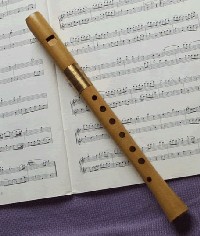
Ganassi Soprano
A = 440 Hz |
An instrument that
combines the sonority of the Renaissance with powerful
tone and subtle articulation. Excellent for playing diminutions
or as part of an ensemble.
Original fingering with single holes. In two pieces joined by a brass ferrule.
|
|
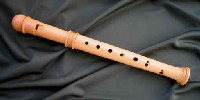
Paetorius Soprano
A = 440 Hz |
A transitional instrument with cylindrical
bore, large tone holes and full upper range with Baroque
fingering. An interesting combination representative
of a period of changes. Single holes.
|
|
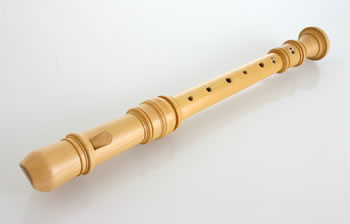
Stanesby
Jr. Soprano
A = 440 Hz |
With bright color and a wealth of overtones,
a responsive instrument of powerful tone and equal
color throughout the register. Especially suited to
solo playing or for standing out in an ensemble.
| |
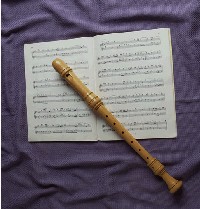
T.
Stanesby Alto
LA= 405 Hz
|
A direct
copy of F. Morgan's drawing of a recorder from the
collection of F. Brüggen, which was used by him in
several recordings. Especially suited for playing Baroque
works, it has a deep and bright tone. The bottom notes
are strong and rich, yet the top register plays freely. |
|
| Contralto J. Denner
La= 415 Hz
La= 392
La = 440 |
Copy of the instrument from Copenhagen Museum, original A=415, without modifications. The authentic sound of the Baroque, deep and warm. Very subtle articulation . Single or double Holes
|
 |
Ganassi
Alto in G
A = 440 Hz
|
With powerful tone and
subtle articulation, this instrument of simple exterior
line is a noble representative of the period; a must for
Renaissance lovers. Original fingering. Made in two pieces
joined by a brass ferrule. |
|
Gurovich
Tenor in C
A = 440 Hz |
Developed
after T. Stanesby alto recorder, it has a powerful tone
throughout. The strong low register and responsive upper
range make it an agile instrument. With or without brass
key, with single or double hole. |
|
|
Gurovich Bass
in F
A=440 Hz |
A lighter weight, precision keys and
gut skins pads, all combine to make it a very responsive
instrument. Its powerful and bright sound, both at the
low end and at the top, make it the ideal instrument
to play basso continuo or in a Renaissance ensemble.
|
|
|
G.A.
Rottenburgh Baroque Flute in D A=415 Hz |
One of
the instruments more widely used to play in A = 415 Hz
due to its excellent tone and balanced intonation.
Made in five pieces with silver key and bone rings. |
|
Stanesby Junior Baroque Flute in D
A = 415 Hz
|
A
little diffused instrument with a very special sonority.
Made in five pieces with tagua rings (vegetal ivory)
and silver key. |
 |
J.H.
Rottenburgh Baroque Flute in D
A = 400 Hz
A = 392 Hz |
A
direct copy of a baroque flute from the Brussels Museum.
Especially suited for playing French Baroque works.
Made in five
pieces with tagua rings (vegetal ivory)
and silver key. |
|
Jacob Denner in D Baroque Flute
(Germanisches Nationalmuseum #257) |
From the clever hands of J. Denner, a 1710 original pitch baroque flute. Generous tone, equal color and volume throughout the register. Synthetic ivory cap and rings. Silver key |
|
|
Stanesby
Jr Baroque Flute A=415 |
In
Ebony and Vegetal Ivory rings |
|
| Baroque Flute in D GA Rottenburgh A=415 |
In Ebony and Vegetal Ivory rings and silver key |
|
|
|
|
Irish Flute in D
A=440
Hz
|
Seven - hole
transverse flute in D for playing Celtic music.
With powerful tone, great agility and accurate intonation, this flute is made
entirely of wood in three pieces, without metal casing, in order to give a lightweight
instrument.
It has an oval mouthpiece, which makes it more adaptable for performers of modern
flute, but it gives, at the same time, a sweet, deep and full tone with remarkable
precision in the attacks.
|
|
|
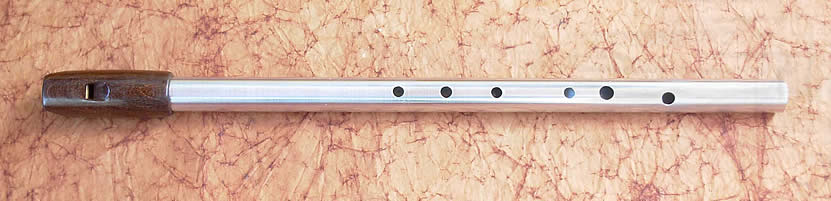
Tin
Whistle in D |
Six
holes Tin Whistle in D.
Fully handmade in two pieces: Guayacán
wood head and cylindric aluminium body.
Two octaves register.
Accurate intonation and pitch adjust slide joint.
High sonority and responsive upper range.
|
 |
Low
Whistle in D |
Six holes Low Whistle.
Fully handmade in two pieces: Guayacán
wood head and cylindric aluminium body. Two octaves register.
Accurate intonation and pitch adjust slide joint.
The bottom
notes are strong and rich, yet the top register plays freely.
|
|
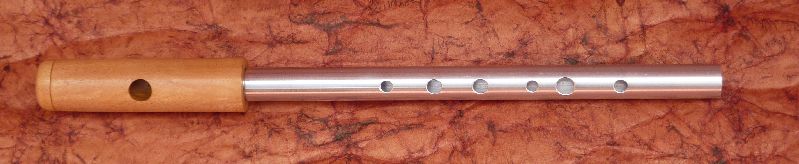
Low Flute in RE |
Flute in D with cylindrical wood head and aluminium body. The instrument is in the equal octave and have the same fingering than the Irish Flute. Very deep and vibrant sound.
Sliding head joint.
|
|
G Flute |
Flute in G with cylindrical wood head and aluminium body, tuned a fourth above of the Irish Flute.
Very powerful sound . Deep low notes and clear high register. A very comfortable and spontaneous instrument.
Sliding head joint.
|
|
Fife Flute in Re |
Piccolo in D one higher octave than Irish Flute.
Traditional Irish instrument. Very high volume and presence.
Cylindrical wood head and aluminium body. Sliding head joint.
|
|